DUI Test Refusal Can Leave You Facing Additional Penalties. Peter Liss Can Help
California law requires drivers to submit to a chemical test when legally arrested for DUI. Refusing these tests can result in separate penalties under California’s implied consent law, including mandatory jail time, an extended license suspension, and no option for a restricted license. You can fight these penalties with a San Diego County implied consent attorney.
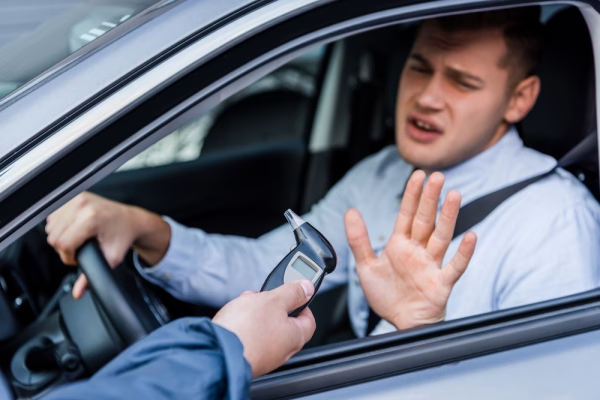
What Is California’s Implied Consent Law?
When you get a driver’s license in California, you sign an agreement stating that if arrested for suspected DUI, you will submit to a breath, blood, or urine test. Simply by driving in California, you agree to chemical testing when requested during a DUI arrest.
When Does Implied Consent Apply?
You are not legally required to submit to a DUI test at any given time. Instead, you can only be convicted of this crime if you were subject to a lawful DUI arrest. This distinction is important because it means that if you are charged with violating the law, your attorney may be able to challenge the allegations if:
- You were asked to submit to the test before being placed under arrest.
- The officer neglected to warn you of the consequences of a DUI refusal in California.
- The officer lacked probable cause or otherwise violated your rights.
Even so, “it is usually better to submit to a chemical test and challenge the results later than risk an implied consent violation,” explains attorney Peter Liss.
There are two critical exceptions in which an individual does not need to be placed under arrest before they must submit to testing: when the suspect is on probation or is a minor under 21. These individuals must submit to a PAS (preliminary alcohol screening) when asked to take one; however, they still have the right to refuse to take a field sobriety test.
What Counts as Refusing a DUI Test?
You don’t have to explicitly say “I refuse to take a test” to be charged under this law. A driver accused of refusing a chemical test under 23612 (VC) for:
- Verbally refusing
- Agreeing only under certain conditions
- Failing to respond to an officer’s request
- Failing to complete the test
- Pretending to blow into the Breathalyzer
- Attempting to manipulate the Breathalyzer
- Repeatedly providing insufficient breath samples
- Refusing to follow testing instructions
- Unreasonably delaying the test
In some cases, a driver may even face refusal charges if they refuse after being read the Implied Consent warning, but then later agree to take the test. On the other hand, someone who has failed to properly complete the breath test can avoid being charged under 23612 (VC) as long as they instead complete a blood test.
Breath vs Blood Tests Under Implied Consent
Most DUIs involve a Breathalyzer, but you can choose a blood test instead. If you do not want to take the Breathalyzer, saying that you wish to take a blood test can help you avoid refusal charges. The option for a blood test was created because some people have medical issues that make breath tests nearly impossible.
Similarly, while those accused of driving under the influence of drugs almost always must submit to a blood test, there are rare conditions where a urine test may be permitted. However, this is not at the driver’s discretion like the Breathalyzer vs. blood test option. Urine tests are not particularly reliable and are only used if someone accused of a drug DUI cannot submit to the test due to a serious medical condition, such as hemophilia.
If a driver refuses to take a chemical test, California law allows police to obtain a warrant authorizing them to physically forcefully administer a blood test. “In Vista and San Diego, sheriff’s deputies and police officers will almost always seek a warrant after a suspect refuses a DUI test, which allows them to restrain DUI suspects and forcibly draw their blood,” says Liss. “When this happens, the driver still faces charges for violating the Implied Consent rule, and the blood test results will be used against them.”
California DUI Test Refusal Consequences
Refusing to take the Breathalyzer or blood test can result in administrative penalties from the DMV and criminal penalties from the court. “The good news is these consequences are enhancements to driving under the influence charges, meaning criminal sentencing can only apply if you are also convicted of DUI,” explains Liss. “However, even if you are found not guilty of DUI or the DUI test showed you were sober, the DMV can still suspend your license.”
If you are convicted in court, you could be subject to:
- Longer license suspensions.
- Higher fines.
- More DUI classes.
- No opportunity for a restricted license.
Specific penalties depend on whether you have any prior Implied Consent violations from the last ten years. These penalties are separate from standard DUI sentences:
| Refusal Number | License Suspension Length | Mandatory Jail Term |
|---|---|---|
| First Offense | 1 Year | 48 Hours |
| Second Offense | 2 Years | 96 Hours |
| Third Offense | 3 Years | 10 Days |
| Fourth Offense | 3 Years | 18 Days |
Additionally, first-time offenders will need to attend a nine-month DUI program, while subsequent offenses require 18 months of classes.
DUI Test Refusal & California DMV Hearings
You can file for an administrative per se refusal hearing with the DMV to avoid an automatic DMV license suspension after an Implied Consent violation. However, you have only 10 days from the date of your arrest to request a hearing.
Unlike administrative per se hearings after a failed Breathalyzer test, hearings for refusing a DUI test do not focus on your BAC (unless you are also fighting a suspension for having a BAC over 0.08%). Instead, your attorney may argue that:
- You were subject to an illegal traffic stop.
- You were not lawfully arrested.
- The officer failed to warn you of the consequences of refusing a chemical test.
This optional hearing does not impact the outcome of your criminal case. However, it can help you keep your license and allow your lawyer to review and challenge the evidence against you. This opportunity could, in turn, help your attorney better fight the criminal charges.
Learn more about DMV hearings here.
Common Implied Consent Misconceptions
Many people don’t understand that refusing a Breathalyzer or blood test is almost always a bad idea. “Some people seem to think that if they refuse a blood or breath test, they can’t be charged with a DUI because there won’t be evidence against them,” says Liss, “but in San Diego County, they will be given a blood test against their will, so all refusal will do is open them up to charges under 23612 (VC)1.”
Some believe refusing a test is better if their BAC is particularly high, but while extra penalties may apply for BACs above 0.15%, most are not mandatory. Even at 0.20%, the only mandatory increase is a longer DUI class, the same as if you refused the test. Beyond that, the fact that police can still get a warrant for a forced blood test means they’ll instead face enhancement charges for a high BAC and for refusing a chemical test.
“The bottom line is that it’s almost always better to take the test and fight the results later than it is to refuse,” says Liss.
Legal Defenses for Test Refusals
While test refusal may render some DUI defenses inapplicable, many common strategies still apply in these cases, including:
- The officer stopped you without reasonable suspicion.
- The arrest was unlawful (often due to lack of probable cause).
- The officer failed to warn you of the consequences of a refusal.
- You agreed to take a test, but the officer did not hear or understand you.
- You attempted to take a test, but were unable to due to a medical issue or equipment failure.
In many cases, the best solution is not to fight the charges entirely, but negotiate a plea bargain that will result in this charge being dropped in exchange for you pleading guilty to DUI.
Learn about other ways your attorney may fight the charges on our DUI defenses page.
How Implied Consent Affects Your DUI Case
If you successfully fight the DUI charges, you will no longer face the 23612 (VC) charges. When your attorney can fight the implied consent charges, it can also inherently undermine your DUI case in many cases. Illegal traffic stops, unlawful arrests, and neglecting to warn a driver about the consequences of test refusal are all defenses for drunk driving as well.
Talk to a Vista Implied Consent Lawyer
If you have been accused of refusing to submit to a Breathalyzer or blood test after a DUI arrest in San Diego County, attorney Peter M. Liss can help. Remember that you only have 10 days to file for an administrative per se hearing to challenge the automatic DMV license suspension.
Please call (760) 643-4050 to schedule a free initial consultation at Peter Liss’ law office located just across the street from the Vista courthouse and jail.
FAQs About Refusing DUI Tests in California
Does California Have an Implied Consent Law?
Yes. Anyone driving within state limits is legally required to submit to a blood or breath test after being placed under arrest for a DUI. Chemical test refusals can result in many penalties, including mandatory jail time, longer license suspensions, lengthier DUI programs, and more.
Can You Still be Charged for Refusing a DUI Test if You Were Sober?
No. Police typically force people to take a DUI blood test against their will after test refusals. If the results show the driver was not driving under the influence, they cannot face criminal charges for test refusal. However, their license may still be suspended by the DMV.
Can I Refuse a Breathalyzer in California?
You have the right to decline a breath test only if you agree to take a blood test instead. If you refuse to submit to any chemical test, you can face criminal charges.
Does Implied Consent Apply to Blood Tests?
Yes. You can face charges for refusing to take a chemical test when arrested for DUI. If the officer suspects you are driving under the influence of alcohol, you have the option of a blood or breath test. However, for drug cases, you must submit to a blood test unless you suffer from a dangerous medical condition that makes blood draws impractical, such as hemophilia.
What if I Wasn’t Read the Implied Consent Warning?
If the officer failed to warn you about the consequences of test refusal, it could result in the Implied Consent charges being dropped. In some cases, your attorney may be able to use this as evidence that your forced blood draw test results should be suppressed as evidence.
Can I Fight a License Suspension for Refusal?
Yes, but you only have 10 days after your arrest to request an administrative per se refusal hearing with the DMV.
Can Police Force a Blood Draw in California?
Yes. If someone refuses to voluntarily submit to a blood test, police can seek a warrant to take a forced blood draw. Once the warrant is approved, officers can physically restrain a suspect while medical personnel take a blood sample.
Legal References
- Vehicle Code 23612 (VC) (California Legislative Information) ↩︎