Your Vista DUI Lawyer May Use These Common Defenses
Many people accused of driving under the influence feel they have no option but to plead guilty because they failed the blood or breath test. But that’s not the case. Many DUI charges in California can be challenged successfully if weaknesses exist in the prosecution’s evidence, chemical testing procedures, or arrest process.
Attorney Peter Liss is intimately familiar with both common and specialized DUI defenses. Here’s what he thinks drivers should know about DUI defense strategies.
Common DUI Defense Strategies
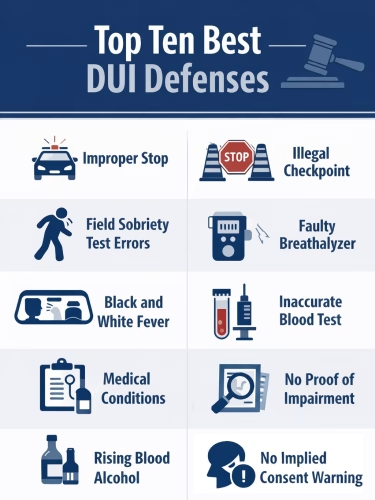
No single defense works for every case. Do not attempt to defend yourself without an attorney. That being said, these are some of the top DUI defenses used by lawyers in California:
Traffic Stop & Constitutional Defenses
- Traffic stops made without reasonable suspicion.
- Detaining a driver for longer than is legally justified.
- Vehicle searches performed without probable cause.
- Arrests made without probable cause.
- Illegally operated DUI checkpoints
DUI Test Defenses
- Field sobriety tests affected by poor weather, improper footwear, or medical conditions.
- Officers failing to provide warnings about the Implied Consent law consequences of refusing to submit to a blood or breath test.
- Improperly calibrated or incorrectly operated breath-testing devices.
- Improper blood draw procedure.
- Medical conditions that may affect breath test results.
- Title 17 violations.
Impairment Defenses
- Rising alcohol defense arguments asserting that a driver’s BAC may have increased after they were driving but before they were tested.
- The ‘black and white fever’ defense, which explains that anxiety about police presence may explain nervous or erratic driving behavior unrelated to intoxication.
- The prosecution has no proof of impairment.
What is the Most Common DUI Defense?
Challenging the evidence of intoxication is probably the most frequently used defense strategy in California. This can be done in many ways, including challenging the admissibility of the evidence by claiming the stop was illegal, questioning the probable cause for the arrest, or demonstrating procedural errors or accuracy issues with the chemical test.
Less Common But Highly Effective DUI Defenses
These defenses may only apply in limited situations, but when applicable, they can be very effective:
- The emergency defense —In genuine, immediate emergencies, it is legally excusable to drive under the influence if there is no alternative available. For example, if a husband faces life-threatening injuries while camping and his intoxicated wife has no cellphone signal, she can drive to seek help.
- Involuntary intoxication —If someone had their drink spiked or unknowingly suffers from auto-brewery syndrome, they can fight the charges based on the fact that they did not willingly break the law. This defense will not work if you realized you felt intoxicated and chose to drive anyway, unless the emergency defense also applies.
How DUI Defenses Work in California
Attorneys know how to use many different strategies to fight DUIs, but case law is very complex. The most common DUI defenses in California are based on technical, procedural, or constitutional issues, though some are complex and applicable only in limited scenarios. Regardless of the defense, the prosecution must prove guilt beyond a reasonable doubt, which can be difficult if the evidence was obtained improperly.
Because what you say to the police could be used as evidence that could harm your defense, it is vital that you remain silent and never say more than you are legally required to without a lawyer present. If you did speak to the police during a DUI arrest, write down everything you can remember after your release because any small detail may help you build a strong defense.
How to Fight a DUI in California by Charge
The most effective defense strategies vary depending on the circumstances. Here are specialized DUI defense strategies based on different offense types:
| DUI Type | Code | Common Defenses |
|---|---|---|
| First Offense | 23152(a) (VC) 23152(b) (VC) |
Civil rights violations Illegal checkpoint No implied consent warning Incorrectly administered blood or breath test |
| DUI with Priors | 23540 (VC) 23546 (VC) 23550 (VC) 23550.5 (VC) |
Civil rights violations Improper application of prior charges Invalid traffic stop Illegal checkpoint incorrectly administered blood or breath test |
| DUI Causing Injury or Death | 23153 (VC) 191.5(b) (PC) 191.5(b) (PC) |
Not intoxicated Not responsible for the accident Intoxication did not cause the accident No negligence, emergency defense |
| Drug DUI | 23152(f) (VC) | No proof of impairment Civil rights violations Questioning the findings or qualifications of the Drug Recognition Expert (DRE) Incorrectly administered blood test |
| Juvenile DUI | 23136 (VC) | Incorrectly administered blood or breath test No implied consent warning Civil rights violations Illegal checkpoint |
Technical & Procedural Challenges to DUI Evidence
Many of the best DUI defenses are highly technical and require an attorney with extensive knowledge of the California legal system. Some examples include:
Title 17 Violations
State law sets strict guidelines for administering chemical DUI tests under Title 17 of the California Code of Regulations. When these procedures are not followed, evidence may be unreliable. Attorney Peter Liss notes that chemical tests are rarely excluded, but Title 17 violations give attorneys an opportunity to challenge DUI evidence and strengthen their case. Common violations include:
- A lack of evidence that the Breathalyzer was properly maintained and calibrated every ten days or 150 uses.
- The officer failed to observe the suspect for 15 minutes before administering the breath test to ensure they did not regurgitate.
- The person administering the test did not supervise the suspect to ensure they used proper breathing technique.
- The testing area contained alcohol, cleanser, or paint fumes.
- The suspect provided only one breath sample, rather than two, or the results of the two samples were wildly different.
- Officers failed to obtain a warrant for a blood sample when the suspect refused to provide one willingly.
- A trained medical provider did not administer the blood test.
- An alcohol-based cleaning agent was used to sterilize the skin before the blood draw.
- The blood vial lacked sufficient anticoagulant and preservative.
- The blood sample was not properly stored or lacked documentation for the chain of custody during its transportation.
- The blood sample is not available for retesting through an independent laboratory.
These potential issues with chemical samples are why you should always document everything you remember from the arrest and DUI test as soon as you are released from police custody.
Learn more about challenging DUI tests here.
Are Breathalyzer Tests Accurate?
They’re accurate enough to use in court. However, there are many things that can affect the accuracy of these tests, which is why Breathalyzer results are so frequently challenged by defense attorneys.
Learn more about factors that impact breath tests here.
Improper DUI Checkpoint Operation
DUI checkpoints must be conducted under a specific set of rules, first established in the 1987 California Supreme Court decision Ingersoll v. Palmer. To be considered legal, they must abide by the following:
- The stop must be set up at a reasonable location, time, and date.
- The department must notify the public days in advance.
- The checkpoint must look official, be neutrally operated, and be safe.
- Drivers have the right to turn around and avoid the checkpoint.
- A supervising officer must be present at all times.
- Drivers cannot be detained for unreasonable periods.
In practice, courts consider the overall circumstances surrounding a checkpoint to determine its legality. Some factors are more significant than others. For example, “it is crucial that a supervising officer is present and that the officers do not discriminate when choosing which driver to investigate,” says Liss.
Where your case is prosecuted can impact how courts enforce checkpoint laws. For example, Liss has found that San Diego County courts are typically less strict about requiring police to announce checkpoints in advance. Checkpoints are not publicly announced in advance in Vista.
For more in-depth information, visit our dedicated DUI checkpoints page.
Civil Rights Violations During the Traffic Stop
Similarly, many laws and court precedents detail police procedures during traffic stops. For example, an officer cannot stop you for an infraction unrelated to your driving and request you take a field sobriety test with no reasonable suspicion that you were driving under the influence. Rules that must be adhered to during the traffic stop and arrest process state that officers must:
- Have a reasonable suspicion that a crime was committed before making a traffic stop.
- Not detain drivers for longer than reasonably necessary. For example, making a driver wait for a drug sniffing dog without evidence of drug use or possession.
- Not ask a driver to take a field sobriety test or chemical DUI test without reasonable suspicion of impairment.
“Illegal traffic stops are the most common reason I have used to get evidence suppressed,” says Liss.
Learn more about DUI traffic stops here.
What If the Evidence Seems Strong?
The majority of criminal cases in California are resolved not through jury trials but through plea bargains. Even if you cannot fully fight the charges, successful DUI defenses can strengthen your case to ensure you receive the lightest possible plea bargain.
The most common DUI plea, especially for those facing first-time charges, is to negotiate the charges down to a wet reckless. This offense can help you avoid a license suspension while also reducing the maximum potential sentence in terms of jail time, fines, and probation.
Those facing more serious offenses can still benefit from pleas. For example, those accused of felony-level charges may have the crimes reduced to misdemeanors, reducing the potential sentence they may face. Or, those facing multiple counts may end up facing only one.
To learn more about this option and how it may benefit you, visit our DUI plea bargains page.
Can DUIs be Dismissed in California?
Yes. DUI charges can occasionally be dismissed in California, but this typically occurs only in limited circumstances involving grave civil rights violations or a lack of trustworthy evidence.
If your attorney cannot get the charges dismissed, a strong defense can still help you secure a more favorable plea bargain.
Why You Need an Experienced DUI Defense Lawyer
A knowledgeable defense lawyer knows how to identify weak points in the prosecution’s case that can help you beat a DUI in California through dismissal or reduced penalties. Among other things, he may:
- File motions for dismissals or reductions
- Question inconsistencies in the officer’s body cameras
- File subpoenas for maintenance records on Breathalyzers, or officer or DRE training records
- Seek alternate sentencing over incarceration
Whatever the specifics of your case, Peter Liss can help with his extensive experience working in local courts throughout San Diego County. He knows how to provide his clients with the best DUI defense strategies tailored to their unique circumstances. He has successfully defended many DUI clients in the North San Diego courthouse across from his office, often achieving dismissals or reduced charges through procedural challenges.
If you have been charged with a DUI in Vista or anywhere else in North San Diego, call Peter Liss today. Schedule a free consultation today by calling (760) 643-4050.
FAQs About Fighting a DUI in California
What Are the Best Defenses for a DUI in California?
There is no single best DUI defense, because each case is unique. A defense that works for one defendant will not necessarily work for another. That being said, some of the top DUI defenses in California include challenging the legality of the traffic stop or checkpoint, questioning the validity of the chemical test, or arguing that the substance did not impair the defendant’s ability to drive.
Can I Fight a DUI Without a Lawyer?
You are not legally required to have a defense lawyer when fighting DUI charges. However, it pays to work with someone who knows how to successfully challenge a DUI in California. An attorney can look for inconsistencies with the prosecution’s case, present evidence to support your defense, and negotiate a far stronger plea bargain than you could do on your own.
How Often do DUI Cases get Dismissed?
There are no solid statistics on DUI dismissals, but statewide, around 68% of cases do not result in convictions. In San Diego County, the number is lower, at around 25%. Regardless of the precise numbers, your chances of securing a DUI dismissal are much greater when you work with a skilled attorney with a working knowledge of the top defenses in your area.
Is it Worth Hiring a DUI Attorney?
Absolutely. If you are acquitted, you will have paid quite a bit less for your lawyer than you would pay in fines. But even if you are convicted, an attorney can play a dramatic role in minimizing your sentencing, fines, and license suspension, all of which will allow you to get back to your own life as soon as possible. In fact, in most misdemeanor cases, a DUI defense lawyer, like Peter Liss, can appear in court and at the DMV hearing on your behalf so you don’t have to take time off work.
Can You be Charged with DUI Without Evidence?
No. DUI charges are primarily based on chemical DUI tests and officer testimony. If none of the evidence against you is considered admissible, your charges must be dismissed.
What Happens if my DUI Test Results Were Wrong?
Sometimes DUI tests are falsely high because the test was done improperly, the testing device wasn’t properly calibrated, the driver has certain medical conditions, or other reasons. In many cases, an experienced DUI defense lawyer can challenge the results to minimize their impact on the case.